
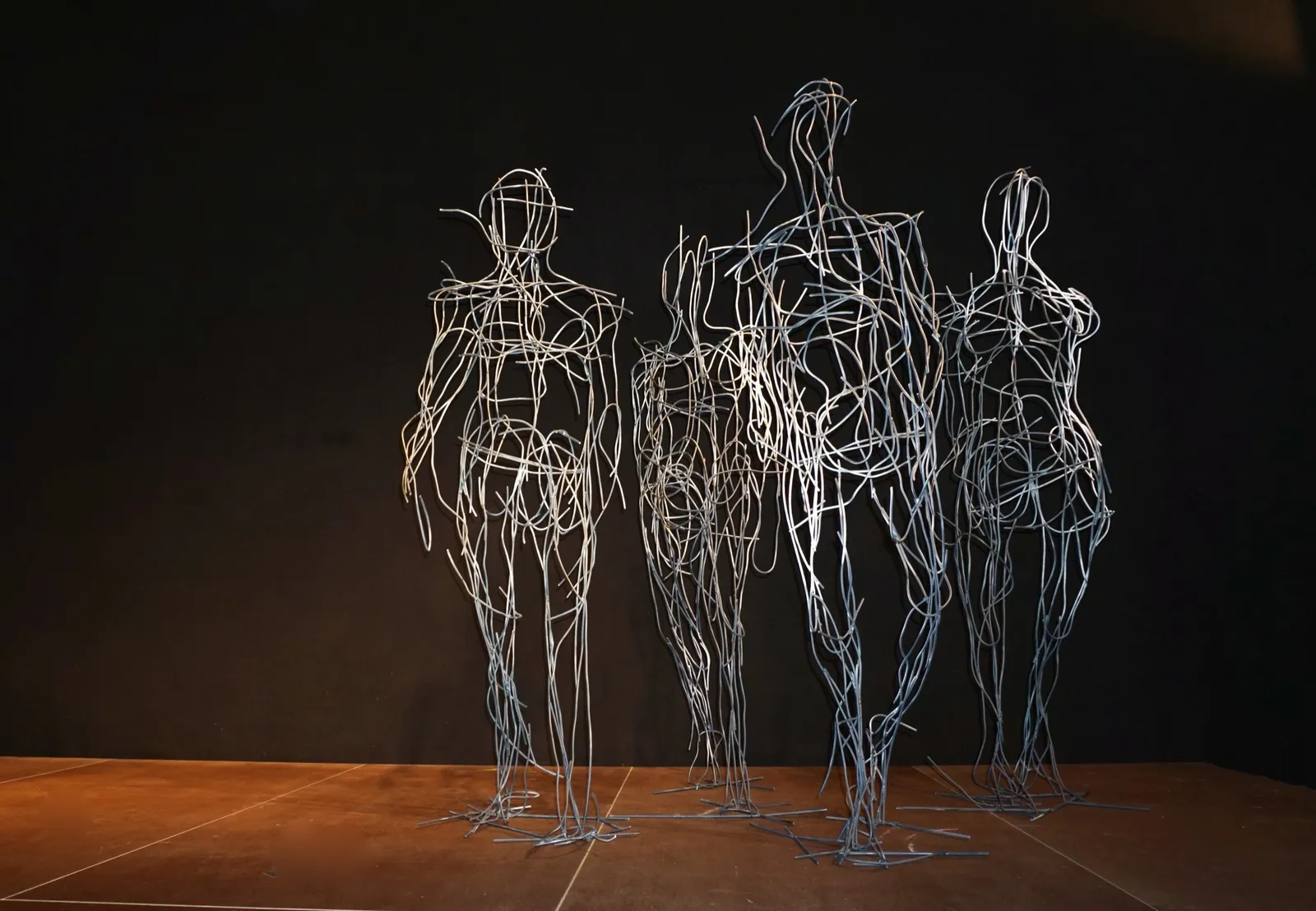
“Exactly the way it's supposed to look.”
There I stood, physically and mentally tense from the past weeks, and heard this sentence. It sounded so self-evident. But the path to a work of art of this dimension lies beyond the self-evident.
In the end, though, everything worked. “Exactly the way it's supposed to look.”
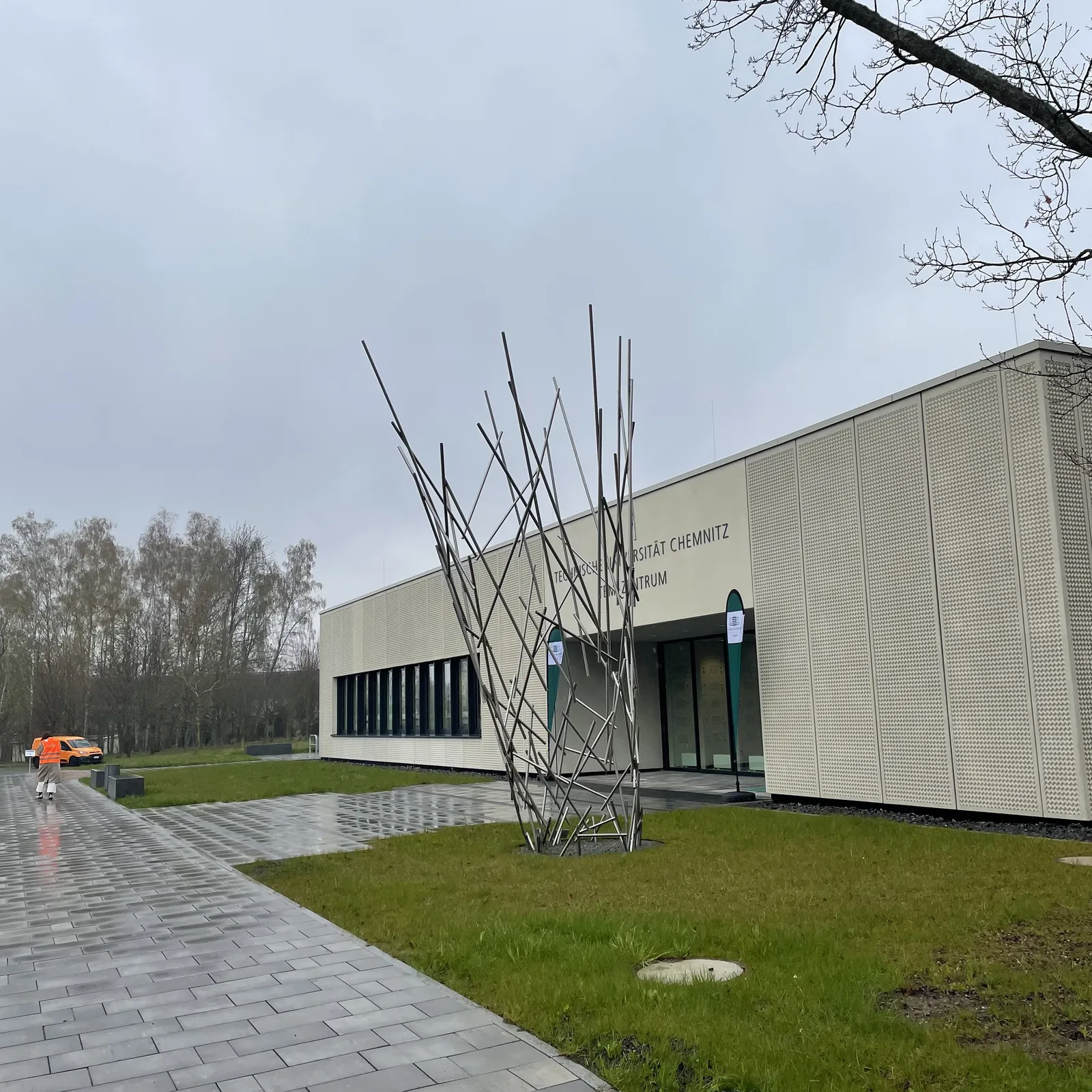
Since summer 2025 my work IMPACT has stood in front of the new building of the Electron Microscopy Institute at TU Chemnitz. The steel sculpture measures 6.50 m in height. 146 stainless steel tubes of different lengths come together in an irregular pattern to form a cone whose tip seems to bore into the ground.
With its filigree and transparency, its sense of direction and dynamic force, IMPACT stands for the interplay between materiality and immateriality, rule and rule-breaking, inner and outer space, connectedness and openness. The form of IMPACT is at the same time a symbol of the focused optical beam of an electron microscope and of the inquiring mind striving for depth. The empty space enclosed by the cone underlines the significance of the space between quantum particles and of emptiness as an essential part of every form and of all material.
But before the cone could seemingly bore into its foundation, I repeatedly focused my attention for several months on the process of developing the work. It was an exciting time, full of valuable encounters, challenges overcome and a tightly scheduled timetable right up to the last move in Chemnitz.
Flashback: the competition decision
In a session lasting several hours with three intensive rounds of evaluation, the jury of the art competition for the new building of the Electron Microscopy Institute at TU Chemnitz decided on 26 January 2024 on one of seven designs that had made it to the final round. The choice fell on IMPACT. (LINK TO THE BLOG POST “THRILLING TO THE VERY END”)
That was the starting signal for my largest work to date, which will have a significant influence on my future work. On the way to its realisation, connections have developed that open up new possibilities for me and let me think in larger dimensions. But what did the path there look like?
From design to structural analysis
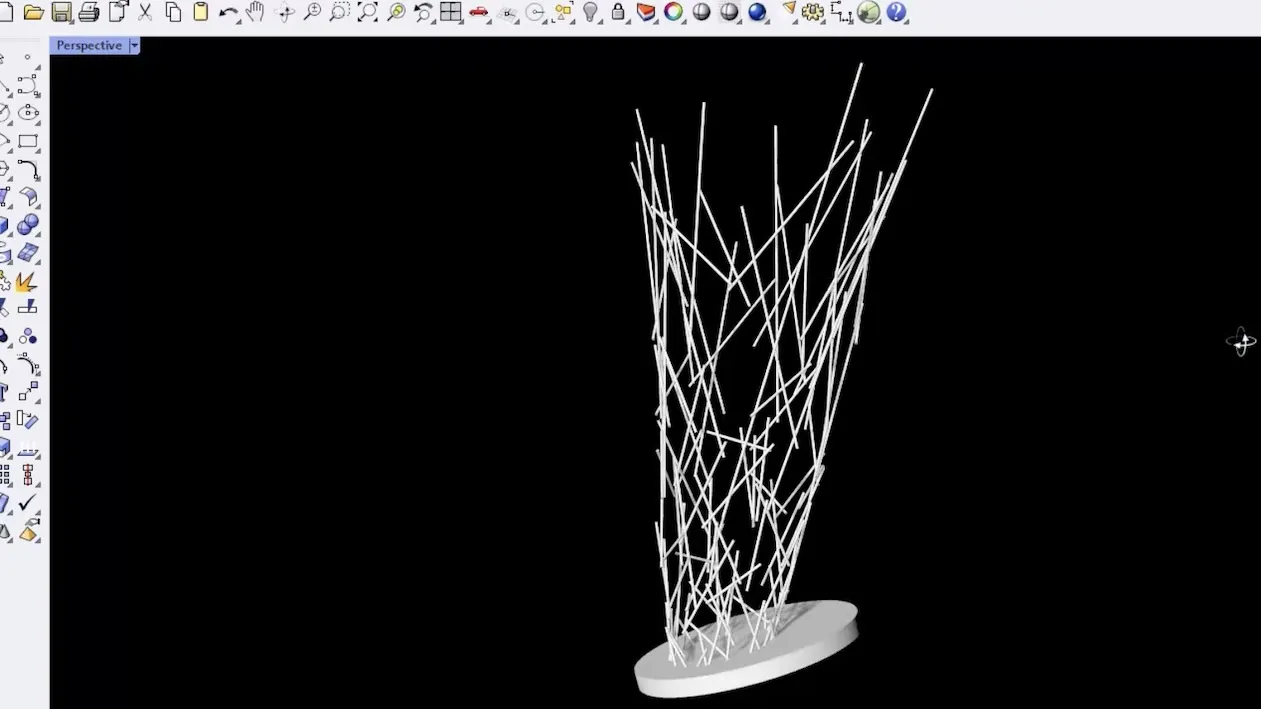
For the competition I had submitted a model and had its feasibility assessed by experts. Now the structural calculations for the realisation had to be made. A design student converted my physical model into a virtual model with a 3D scanner and a lot of painstaking programming.
But which structural engineer understands art? I had already been in contact with many companies about other technical questions, so I asked around there. A stroke of luck: the first tip was a hit.
The structural engineer showed where additional tubes should be fitted into the construction of IMPACT. We implemented the planning virtually on the computer – with great concentration, in order to preserve the overall composition, because the structure develops its tension from the fact that everything is oblique-angled and irregular.
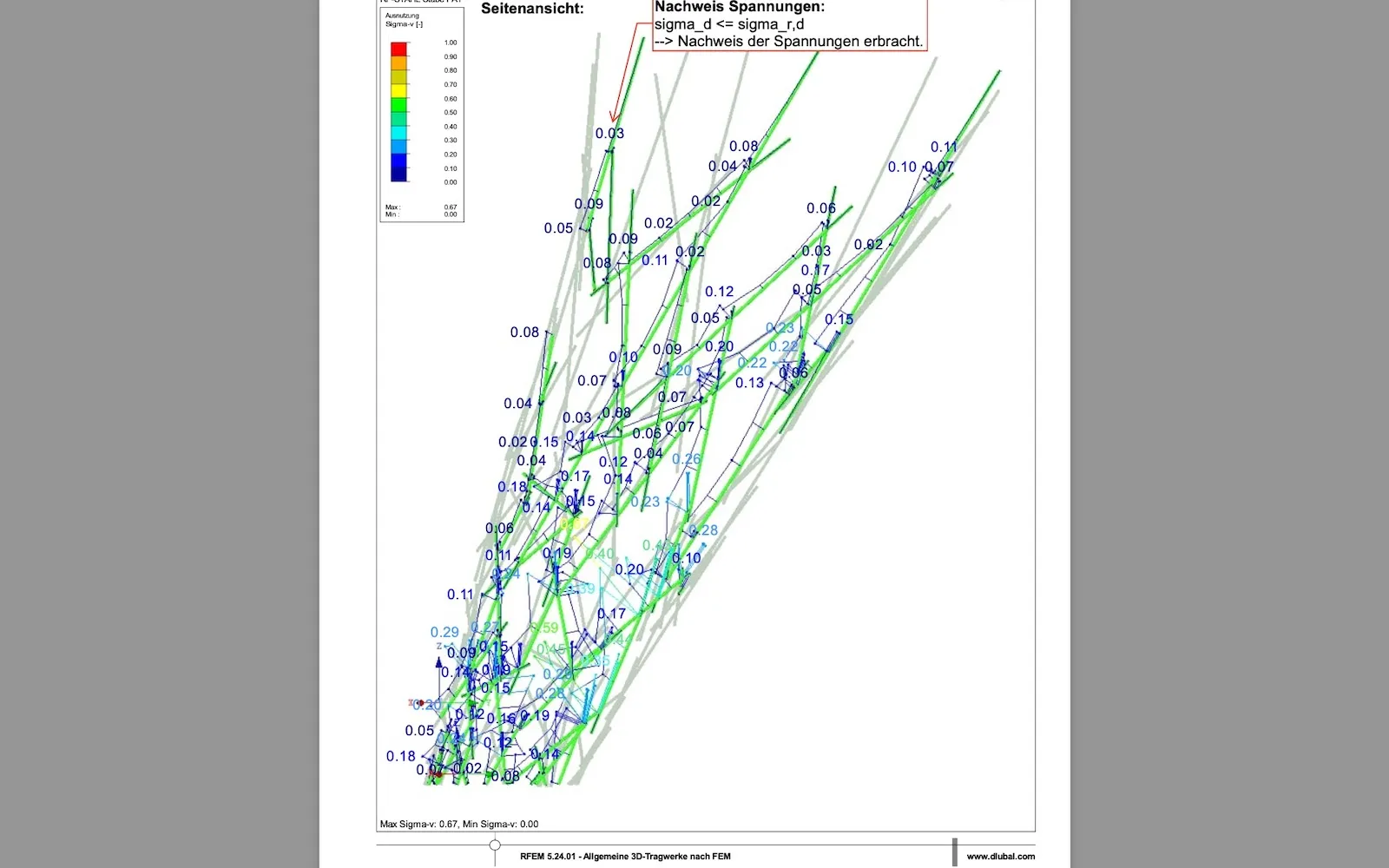
A construction of 146 tubes
In the meantime, the 30 stainless steel tubes with a diameter of 33.7 mm – bundled into a compact, 6 m long package – had arrived at my studio.
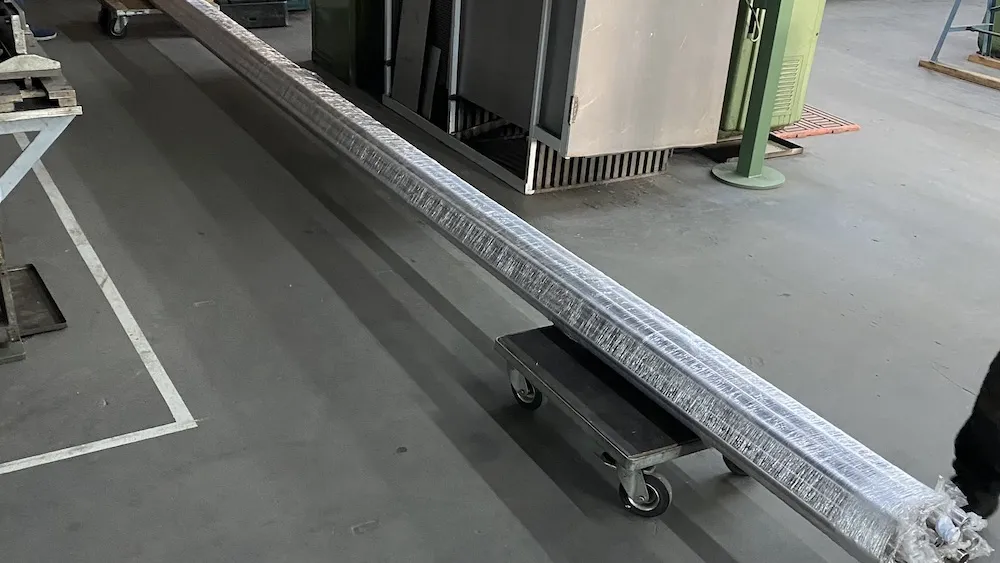
Each individual tube had to be numbered and cut to exactly the right length with a straight cut. An angle grinder was no use for that. But my studio is located in an extensive building complex that is also home to my landlord's engineering works. We benefit from our unusual neighbourhood, so the nearest large industrial saw was not far away, and I was allowed to use it.
At first it was not clear where I would carry out the final assembly of IMPACT. But for the process it was important to settle this question. Should I transport the work to Chemnitz in several parts? How would I join it together there? At the beginning I had even considered driving the parts of IMPACT to Chemnitz on a trailer – in the end a 40-tonne truck was used for the 500 kg work of art!
A disconcerting perspective and a lot of trust
I made a mould like the one I had already built for the model – this time 7 metres long. Four semicircular segments of cut sheet steel were connected with battens. At the bottom the mould had the smallest circle diameter of IMPACT, at the top the largest.
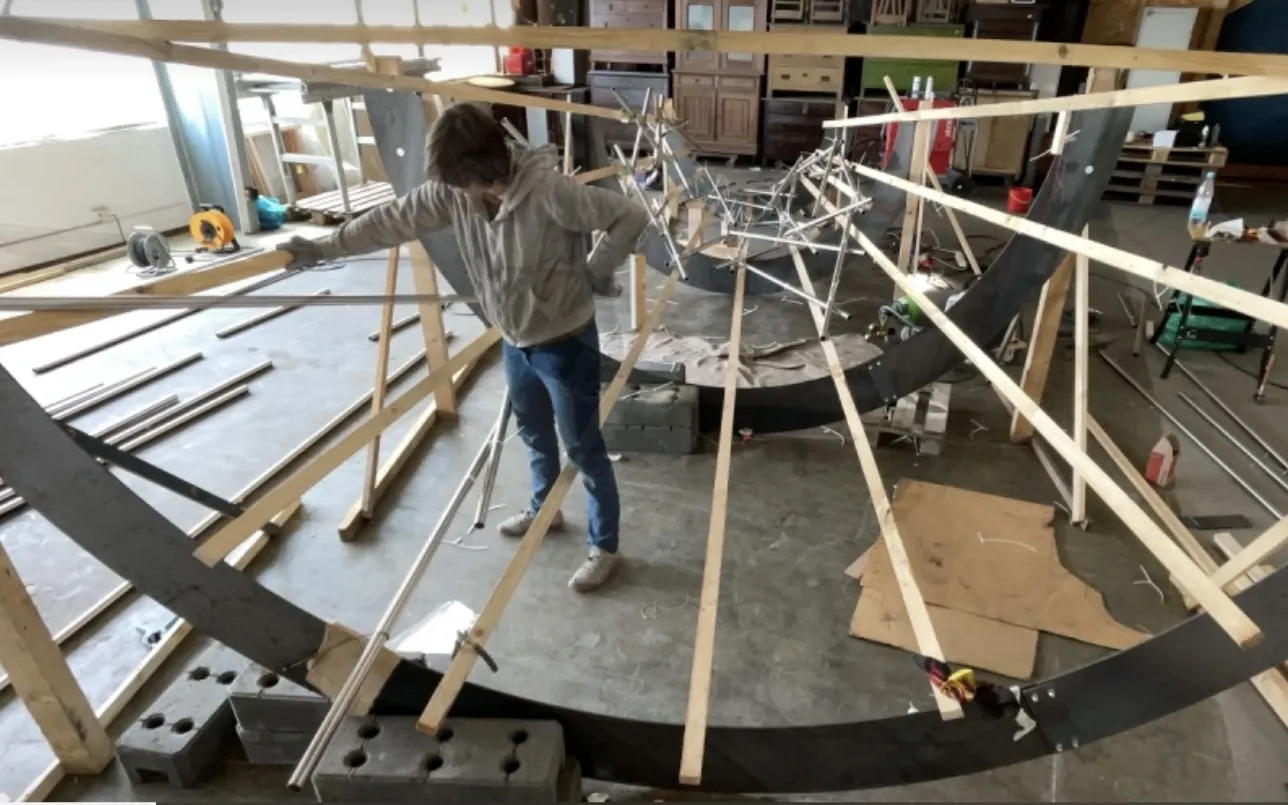
In this mould I began to place the tubes as set out in the construction plan derived from the virtual model. Everything lying down, and with a great deal of trust in the calculations – because visually it looked disconcertingly different. I had imagined IMPACT longer and slimmer. Visitors to the studio were surprised too. Again and again I measured. “The dimensions are right,” I reassured myself.
One welder, many seams and a double feat of strength
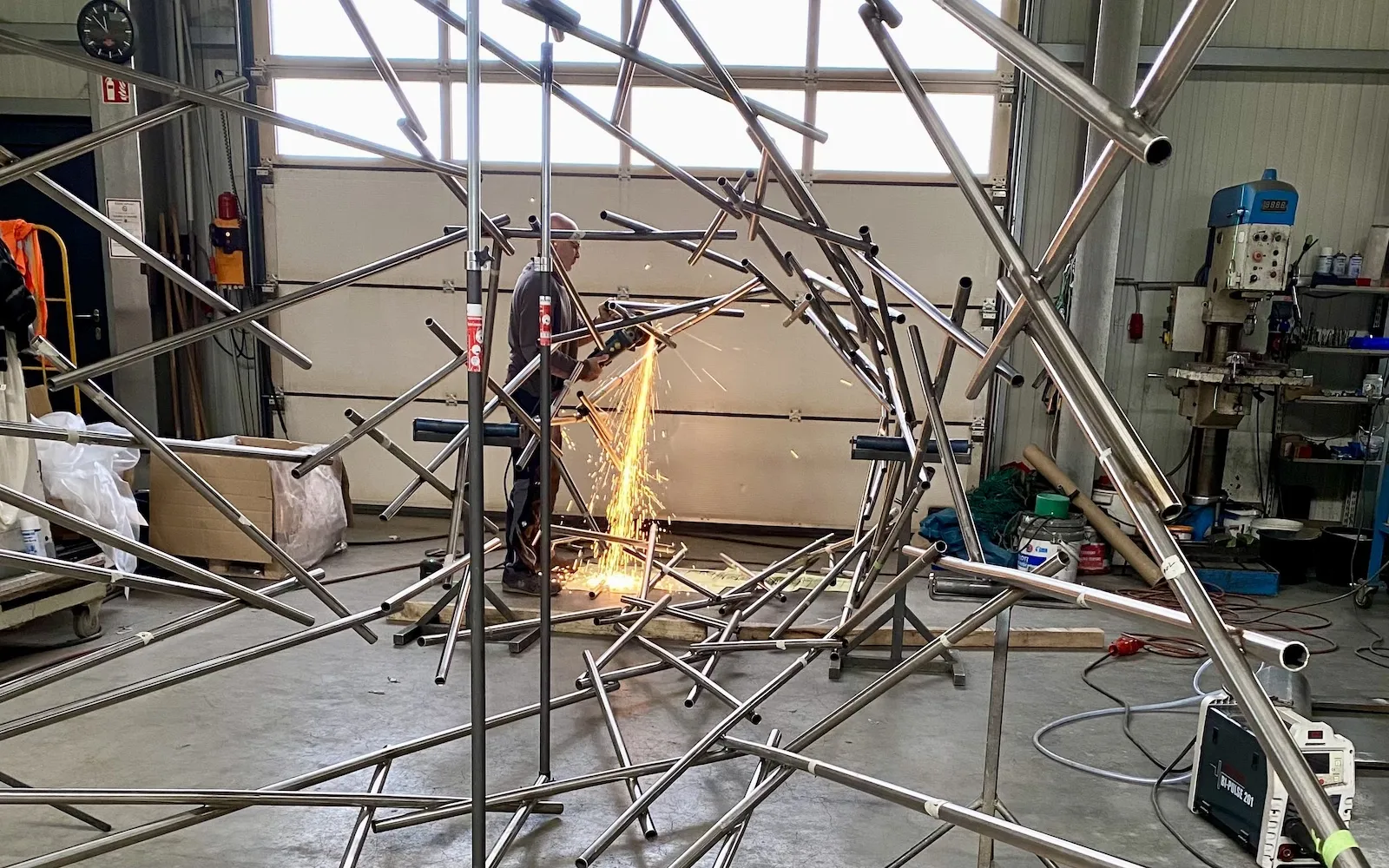
Finally a welder came to the studio. I would have loved to weld the tubes myself, but only a welder certified for construction work was allowed to do the job. First he tack-welded all the tubes to connect them, then he welded each tube with a continuous fillet weld that had to be cleanly closed.
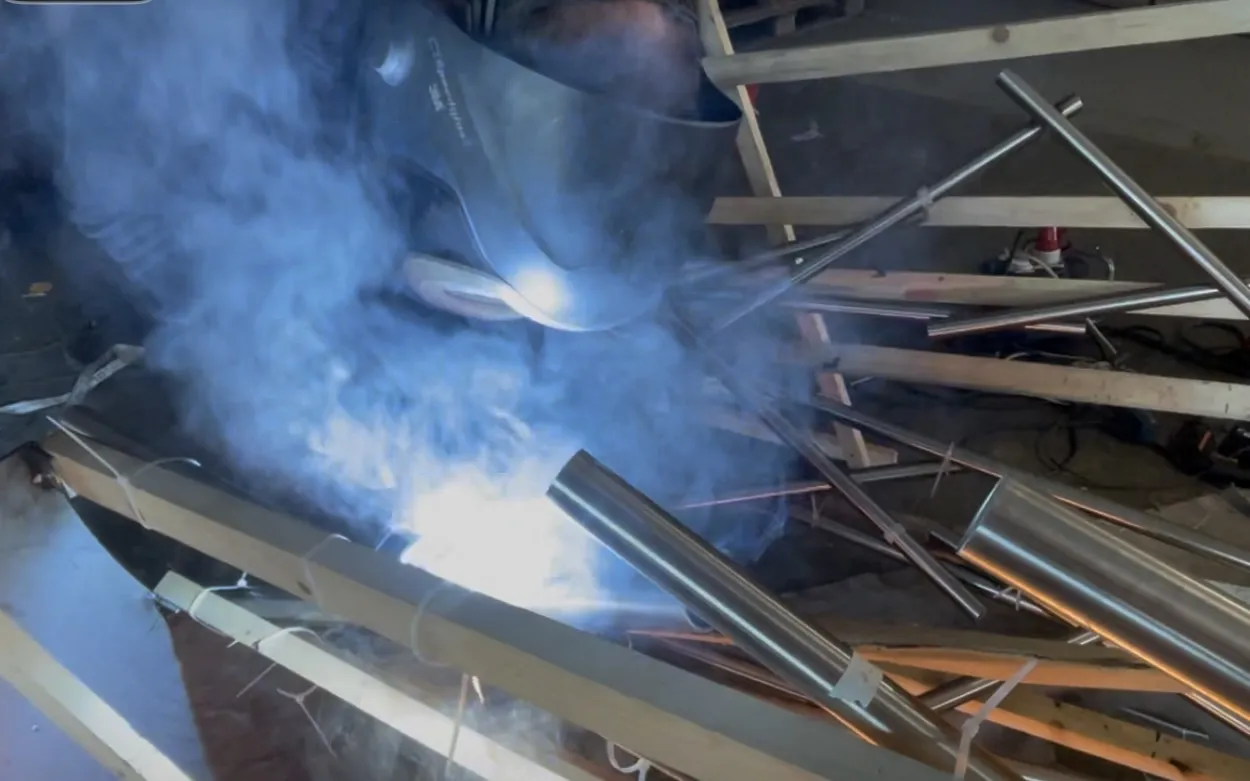
However, I did not want rough welds but smooth ones. So every single seam was reworked with a TIG welder, cleaned and ground. An enormous effort that can hardly be imagined with 146 tubes and so many points of contact. It was exhausting – and time was running ever faster towards the installation date.
Five men had to lend a hand to lift the first half of IMPACT out of the mould so that it was free for the second half.
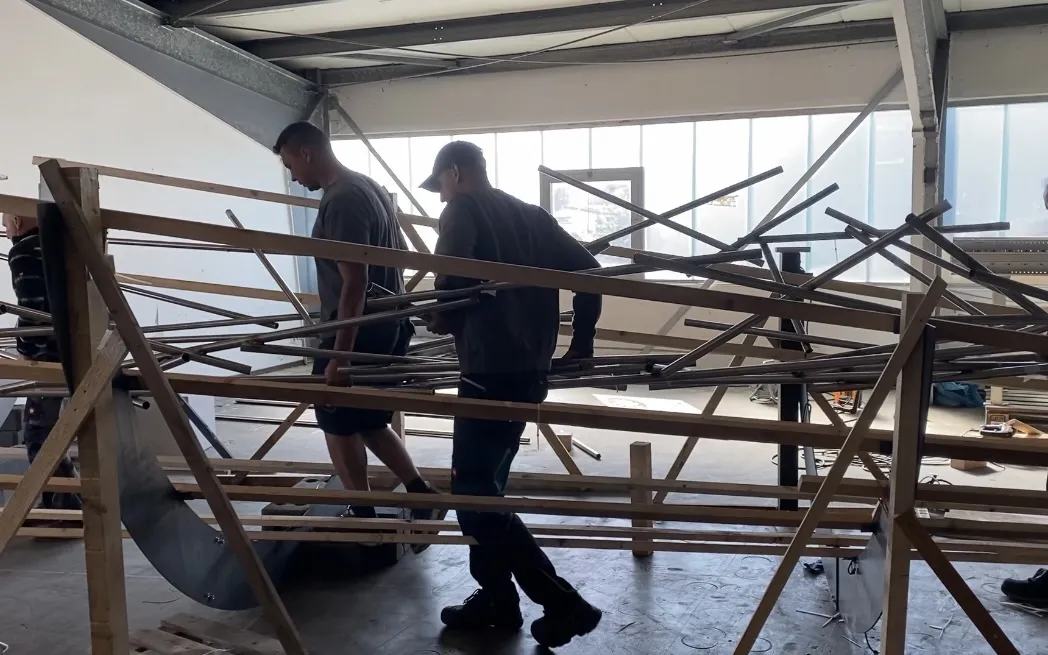
Finally, with many strong hands, a forklift and a large, long pallet, both parts could be turned out through the studio door and loaded onto a trailer to be taken to the large assembly hall of the neighbouring metalworking company. In S&T Metallbau I had found a good partner for the realisation.
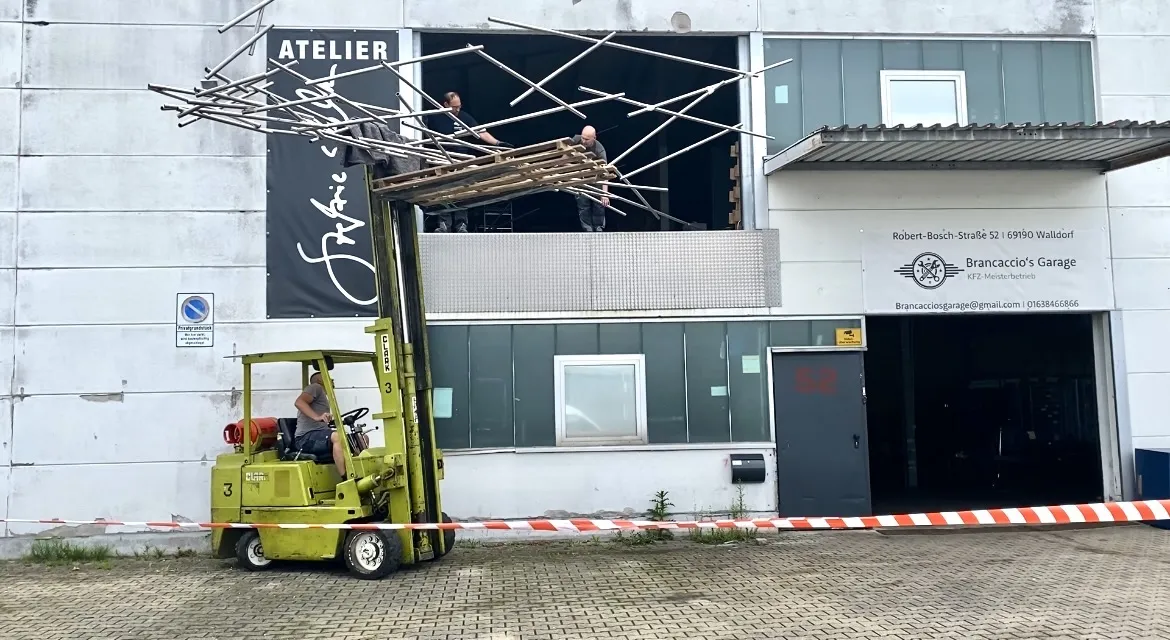
The thrilling moment: floating certainty
While the lower half lay on the ground secured by supports, the second floated down from a forklift into position. But what exactly did the right position look like? Joining the two halves was actually supposed to take only two hours, because the hall was already booked for other projects. But it simply couldn't be done that fast. Precision came before time pressure as the last connecting tubes were welded on and the seams were once again cleaned, ground and polished.
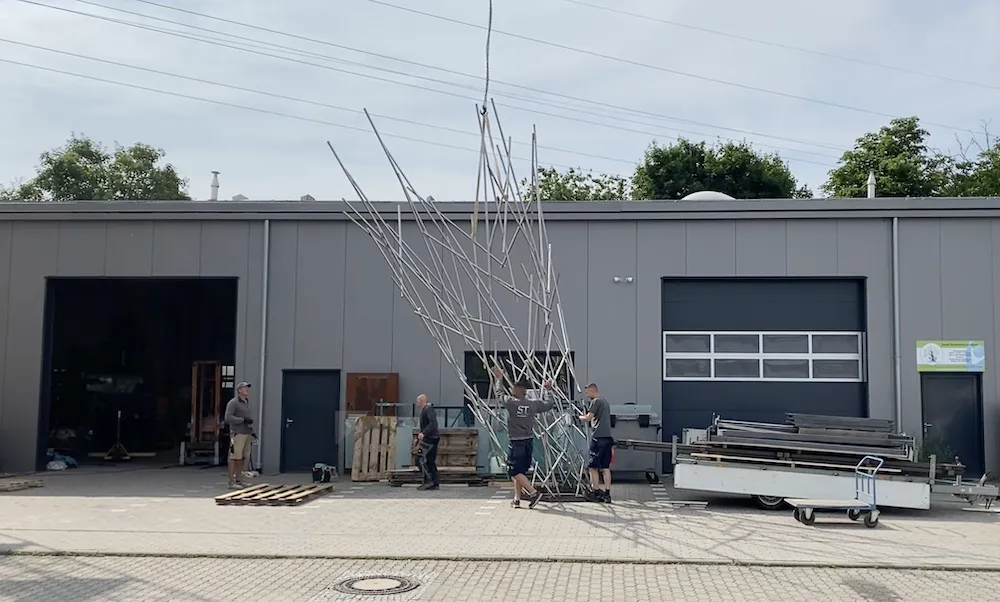
Shortly before transport to Chemnitz, the moment finally came: with a construction crane that “happened” to be on site, we let IMPACT glide, floating, into the right position and were able to experience the work as it would later stand on the TU campus. Slender, filigree and at the same time mighty. That this crane was in the right place at exactly the right time and was available for loading shortly afterwards was one of the happy coincidences during the realisation of this project. But I also count among them the many people who accompanied and actively supported the work on IMPACT with their know-how and incredible commitment.
“Think big” on the way to Chemnitz
It was a hot summer's day when I finally drove to Chemnitz with one of the owners of the metalworking company. We had a template with us to set the drill holes for fixing IMPACT into the foundation. The procedure is precisely prescribed: for each anchor, after drilling, the drilling dust has to be blown out of the hole with bellows. Then you drill again, blow again, drill and blow. We set the first three anchors so that we could position IMPACT with them the next day.
Between 8 and 9 o'clock the following morning, the 40-tonne truck bearing the fitting slogan “Think big” was due to arrive at TU Chemnitz. I was glued to the phone. Where is the truck? When will it arrive? When is the crane coming to unload IMPACT? Everything was planned – except that the truck was due to pick up its next load at 9 o'clock. It arrived at 8, at the wrong gate. The crane was still on its way. What now?
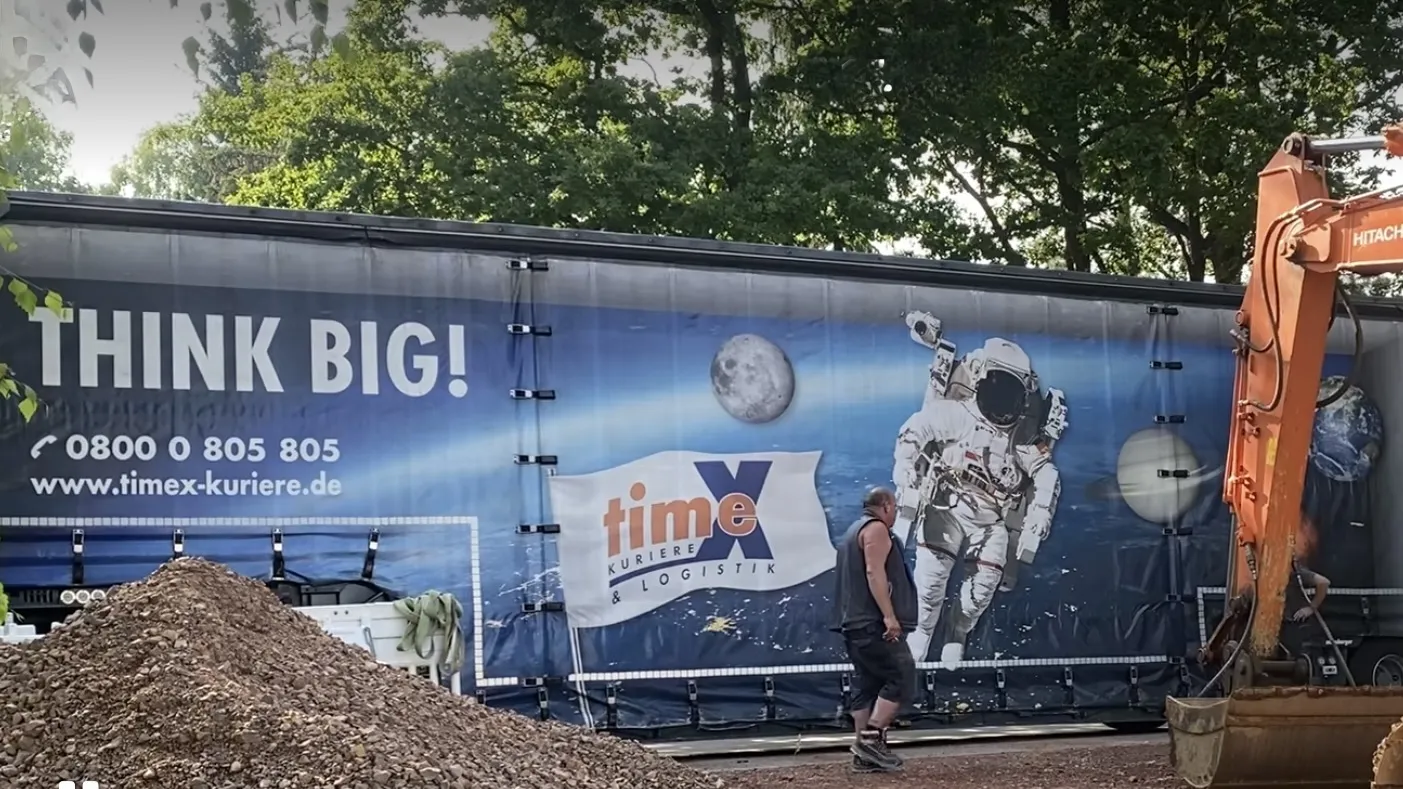
There was a route leading from another entrance to the installation site. It was shorter, but muddy. Yet here too, a happy coincidence: a crawler excavator was on site for the outdoor works. The bucket was quickly removed and the vehicle directed to the truck. However, the excavator was too small for erecting the work – it could not reach the required height. So we waited for the crane.
It arrived punctually at 9 o'clock, was unloaded, moved into position and then operated by remote control. “What a toy,” I thought. As IMPACT floated above the foundation, a single finger was enough to move the work. The goal was to position it to the millimetre. Finally one of the construction workers took hold. Bang. That was it. IMPACT had successfully taken its place. Now only the remaining anchors had to be set and tightened exactly according to the regulations.
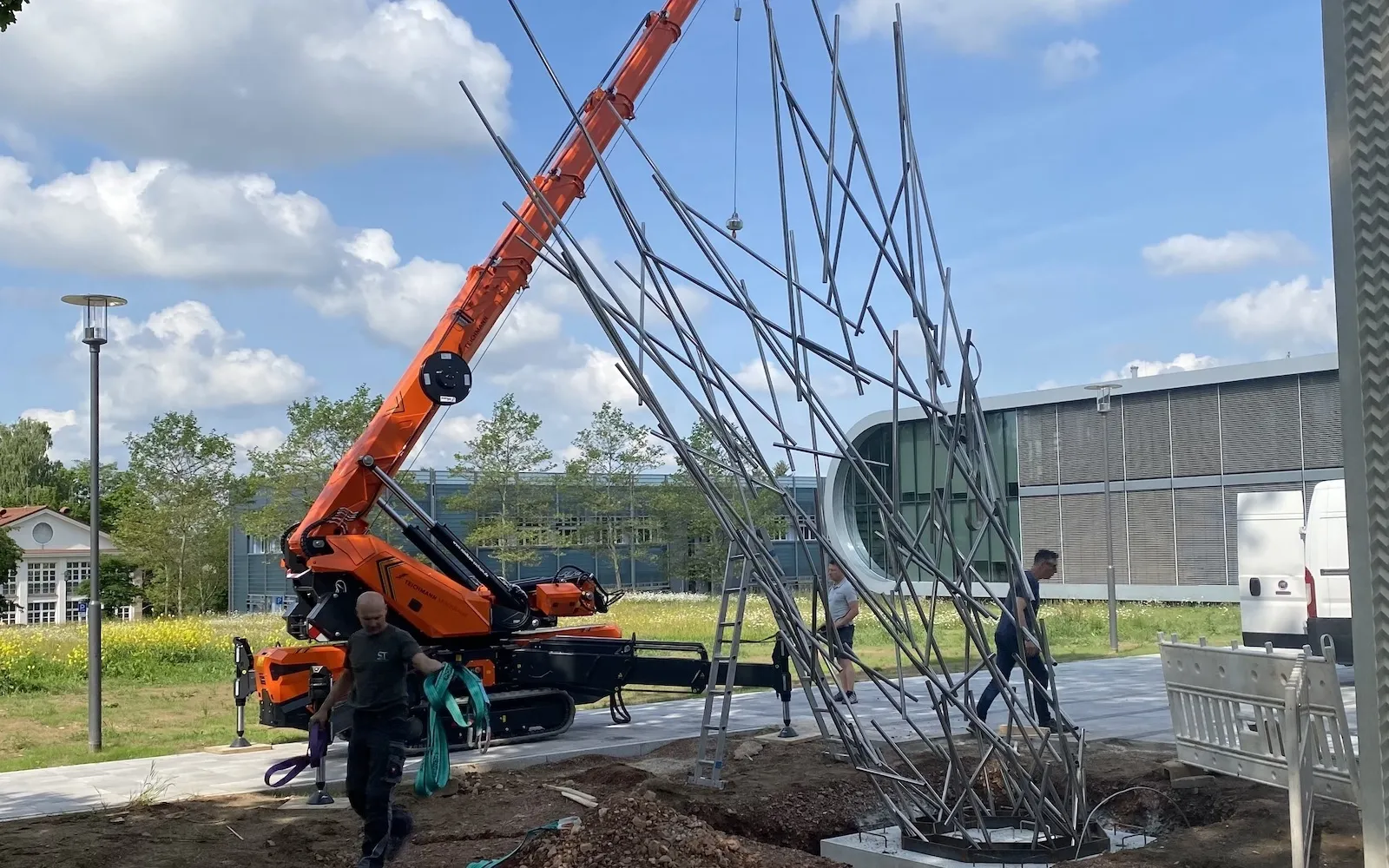
“Great, Ms Welk,” I heard the person in charge from the Saxon State Office for Real Estate and Construction Management say. “Yes,” I thought, “great that we managed it so well!”
For a week after my return from Chemnitz I walked through my life as if in slow motion, enjoying having completed this work bang on schedule.
Since then I have been full of energy for new works and projects. The next competition entry is already finished, and I am working on designs for large-scale works. IMPACT may take effect – in my further work as well.
I will show a short film about the making of IMPACT for the first time on 25 October at Robert-Bosch-Straße 52 in Walldorf. The Open Studio day begins at 2 pm, admission is free, registration is welcome!